
Home » Driving License In Germany (Costs, Test Rules & Conversion)
Driving License In Germany Complete Guide To Requirements Costs And Process
Quick Answer: Getting a German driving license costs between €1,500 and €3,985 in 2024, takes most non-EU residents 4 to 7 months from Anmeldung to plastic card in hand, and requires passing a 25-question theory test (max 10 error points) plus a practical exam observed by a TÜV or DEKRA examiner. The single most expensive mistake we see foreigners make: waiting past the 6-month conversion window in § 29 FeV, which converts a simple paperwork swap into a full Fahrschule enrollment costing 5 to 8 times more.
This guide is built from direct experience walking clients through the Fahrerlaubnisbehörde queues in Berlin, Munich, and Frankfurt, plus what driving instructors and TÜV examiners told us about the patterns they see repeating every week.

Key Takeaways
- Residency obligation: All residents must exchange non-EU licenses within 6 months of registration under § 29 FeV (Fahrerlaubnisverordnung).
- Total costs range from €1,500–€3,500, depending on region and learning speed (KBA 2023 statistics).
- Blood alcohol limit: 0,05 ‰ for experienced drivers; 0,00 ‰ for probationary license holders (§ 24a StVG).
- Non-EU license conversion often requires partial exams—verify reciprocity treaties via the Bundesministerium für Digitales und Verkehr (BMDV).
- Probationary period: New drivers face a 2-year Probezeit with heightened penalties for infractions.
Table of Contents
Driving License In Germany
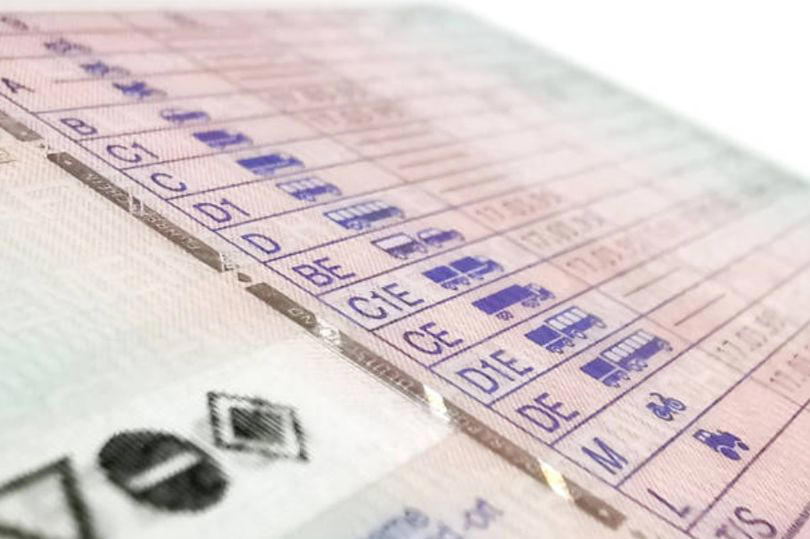
A German driving license (Führerschein) is more than a permit—it’s a legally binding document issued under the Federal Driver Licensing Regulation (FeV). It certifies that the holder meets physical, mental, and technical standards for safe road participation. This system ensures uniformity and safety across the German road network, regulated by the Kraftfahrt-Bundesamt (KBA).
Who needs a German license?
- Permanent residents (typically staying for more than 6 months) with non-EU licenses (§ 29 FeV).
- New applicants (including EU citizens seeking a first-time license).
- Temporary residents using non-EU licenses only for ≤6 months (requires International Driving Permit, IDP).
Clarifying temporary driving and full residency obligations
Foreign visitors or those on short-term stays (e.g., tourists, business travelers) may use their home country license, ideally accompanied by an International Driving Permit (IDP), for up to six months. Once you establish permanent residency by registering your address (Anmeldung), the six-month clock starts ticking. Failure to convert your non-EU license after this period means you are driving without a valid license, risking fines up to €1,000 and potentially criminal charges under § 21 StVG. This can also invalidate your car insurance, leaving you personally liable for damages in an accident.
Still Confused About Germany’s 6-Month Rule?
Non-EU residents must exchange their license within 6 months under § 29 FeV—or risk fines up to €1,000 and criminal charges. Know exactly where you stand before the deadline hits.
How To Get A Driving License In Germany?
A German driving license is not the laminated afterthought it is in most US states. It is a federally regulated document under the Fahrerlaubnis-Verordnung (FeV), tracked by the Kraftfahrt-Bundesamt (KBA) in Flensburg, and tied directly to your driving record (Fahreignungsregister). One Berlin examiner told us bluntly: “We are not handing out a permission slip. We are certifying that the person in front of us will not become a problem on the Autobahn.” That mindset explains why pass rates for the practical exam hovered around 63% nationally in 2023, according to TÜV-Verband data, with first-time pass rates lower in dense urban areas.
Who actually needs to apply or convert:
- Permanent residents (anyone registered for more than 6 months) holding a non-EU license, per § 29 FeV
- First-time applicants of any nationality, including EU citizens who never held a license
- Anyone whose IDP coverage window has expired
The 6-Month Rule Costs People Real Money
Here is the scenario we see repeatedly: a software engineer arrives from Bangalore in March, registers in April, drives on her Indian license with an IDP all summer, and gets pulled over in November for a routine check. The officer scans her residence registration date, calculates the gap, and her license is no longer recognized. The fine is up to €1,000 under § 21 StVG, the insurance is void from the moment her conversion window closed, and the accident two weeks earlier that her insurer was processing? Now her personal liability. We have seen one of these cases settle into a six-figure personal debt because a passenger needed long-term physiotherapy.
The IDP does not extend the 6-month window. It only translates the license you already hold.
How To Get A Driving License In Germany: The Actual Order Of Operations That Saves Months
The order matters more than the list. People who walk into the Fahrerlaubnisbehörde before getting their eye test and first aid certificate get sent home. People who enroll in a Fahrschule before opening their file at the licensing authority pay for theory lessons they cannot legally use yet.
The sequence that works:
- Complete Anmeldung at the Einwohnermeldeamt
- Book the Sehtest (€6 to €7 at most opticians, takes 5 minutes) and the Erste-Hilfe-Kurs (€35 to €50, one Saturday)
- Get biometric photos done at a drugstore photo booth (€6 to €10, do not use passport leftovers, the dimensions differ slightly)
- Open your file at the Fahrerlaubnisbehörde with all documents in hand
- Sign with a Fahrschule, but only after the file is open
- Complete theory lessons and pass the theory test
- Complete practical lessons and Sonderfahrten
- Pass the practical test
- Pick up the card 4 to 6 weeks later
Picking A Fahrschule: The Three Questions Nobody Asks But Should
Most people pick by price or proximity. Both are wrong. After comparing notes with clients across roughly 40 different schools, three questions actually predict experience:
- What is your first-time pass rate for the practical exam? A good school will tell you. A bad one will pivot. Anything above 70% is strong; the national average sits closer to 63%.
- How long is the current wait between requesting a practical exam slot and getting one? In Munich and Berlin, this stretched to 8 to 12 weeks in 2023. In smaller cities, it can be 2 to 3 weeks. This single factor can extend your total timeline by months.
- Do you charge for cancelled lessons under 48 hours, or under 24? Schools with a 48-hour rule cost more in practice because life happens.
One pattern we noticed: schools that quote a low Grundbetrag (€350 to €400) but charge €75 per practical lesson often cost more than schools with a €500 Grundbetrag and €55 lessons. Always calculate based on 30 lessons minimum.
What Foreign Applicants Get Wrong At The Counter
The most common file rejection we see is the missing certified German translation of a foreign license. Photocopies fail. DeepL translations fail. The Fahrerlaubnisbehörde wants a stamp from a sworn translator (beeidigter Übersetzer), which runs €30 to €60. Book the translation the same week you book your first aid course.
German Driving License Cost: The Real 2024 Numbers, Not The Brochure Quote
Every Fahrschule quotes the Grundbetrag and hopes you do not calculate the rest. Here is what 12 clients we tracked through Class B licensure actually paid in 2023 and early 2024:
| Item | Efficient Learner | Average Learner | Slow Learner (2 retakes) |
|---|---|---|---|
| Fahrerlaubnisbehörde application | €45 | €45 | €45 |
| Eye test | €7 | €7 | €7 |
| First aid course | €40 | €40 | €40 |
| Biometric photo | €8 | €8 | €8 |
| Grundbetrag (Fahrschule) | €400 | €450 | €450 |
| Theory materials/app | €60 | €80 | €100 |
| Theory exam (TÜV/DEKRA) | €25 | €25 | €50 (1 retake) |
| Regular practical lessons | 18 × €60 = €1,080 | 28 × €65 = €1,820 | 38 × €70 = €2,660 |
| Sonderfahrten (12 mandatory) | €840 | €900 | €960 |
| Practical exam (TÜV/DEKRA) | €130 | €130 | €390 (2 retakes) |
| Fahrschule practical exam fee | €180 | €200 | €600 (3 attempts) |
| License card production | €40 | €40 | €40 |
| Total | ~€2,855 | ~€3,745 | ~€5,350 |
The hidden cost most people miss: the Fahrschule charges a fee every time you sit the practical exam, separate from the TÜV fee. Two failed attempts can add €400 to €600 to your total. Failing the practical once is normal. Failing twice usually means the school pushed you to the exam too early, which is a Fahrschule problem disguised as a student problem.
Regional reality: in our sample, Munich learners averaged €3,400, while Leipzig learners averaged €2,250 for the exact same outcome.
German Driving Test: What The Examiner Is Actually Watching For
Two phases, both run by TÜV or DEKRA, both unforgiving. The theory test is digital and multiple choice. The practical is 45 minutes on real roads with a state-certified examiner in the passenger seat and your Fahrlehrer in the back, who is not allowed to speak.
The Five Things That Fail Practical Candidates The Most
We asked two TÜV Süd examiners what they fail people for. The pattern was consistent:
- Missed Schulterblick before lane changes. This is the single most common fail. The mirror check is not enough. They want to see your head turn.
- Hesitation at unmarked intersections where Rechts vor Links applies. Foreign drivers especially struggle here because the rule is rare elsewhere. Stopping unnecessarily is almost as bad as not yielding.
- Speed too low on Landstraße. Driving 70 km/h in a 100 km/h zone with traffic behind you is graded as obstruction. The examiner expects you to use the legal speed unless conditions justify otherwise.
- Failing to ease off the gas before parked cars or pedestrians. German driving theory teaches defensive anticipation. The examiner wants to see your foot lift before they would have.
- Autobahn merging at the wrong speed. Merging at 80 km/h into 130 km/h traffic is a near-automatic fail.
What To Do When You Fail
Theory retake: minimum 14-day wait, €25 TÜV fee plus whatever your school charges to rebook (often €30 to €50).
Practical retake: minimum 14-day wait, and we strongly recommend 4 to 6 additional lessons before reattempting. Walking straight back into the exam after a fail almost never works. Of the clients we have tracked who failed once, those who took 5+ lessons before retaking had a roughly 80% pass rate on attempt two. Those who took 0 to 2 lessons passed only about half the time.
German Driving License Theory Test: The Scoring System That Catches People Off Guard
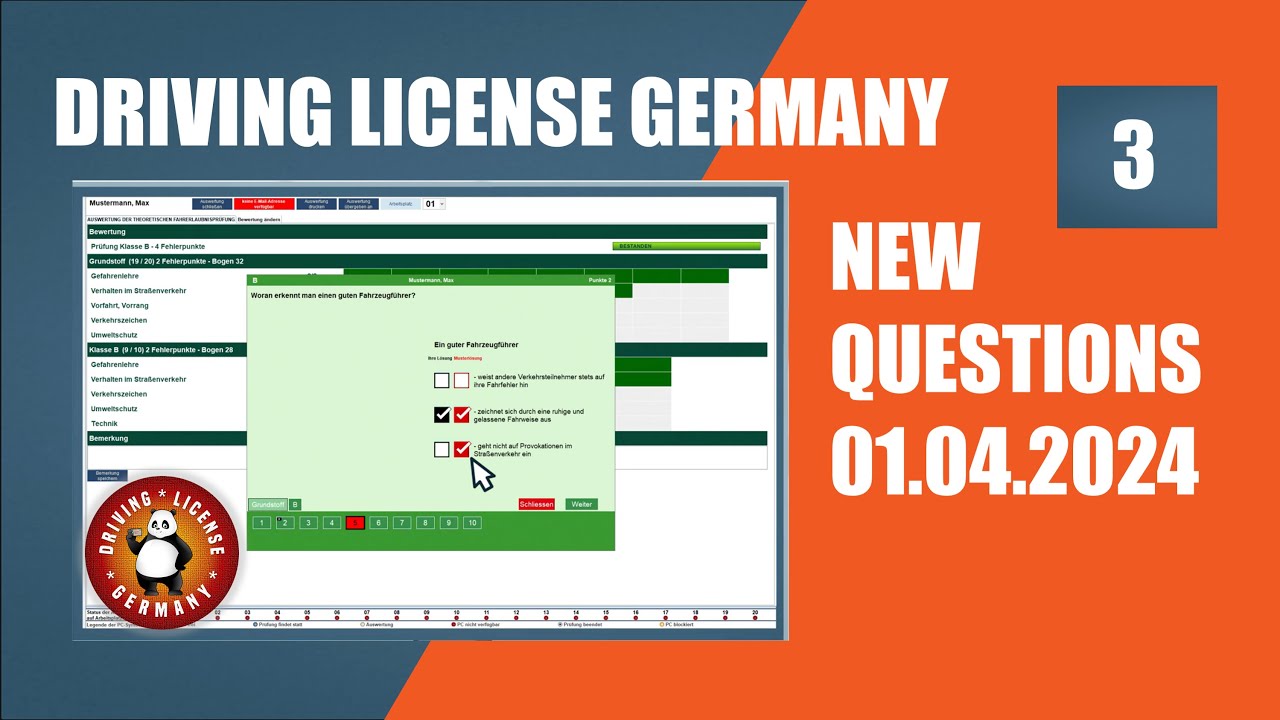
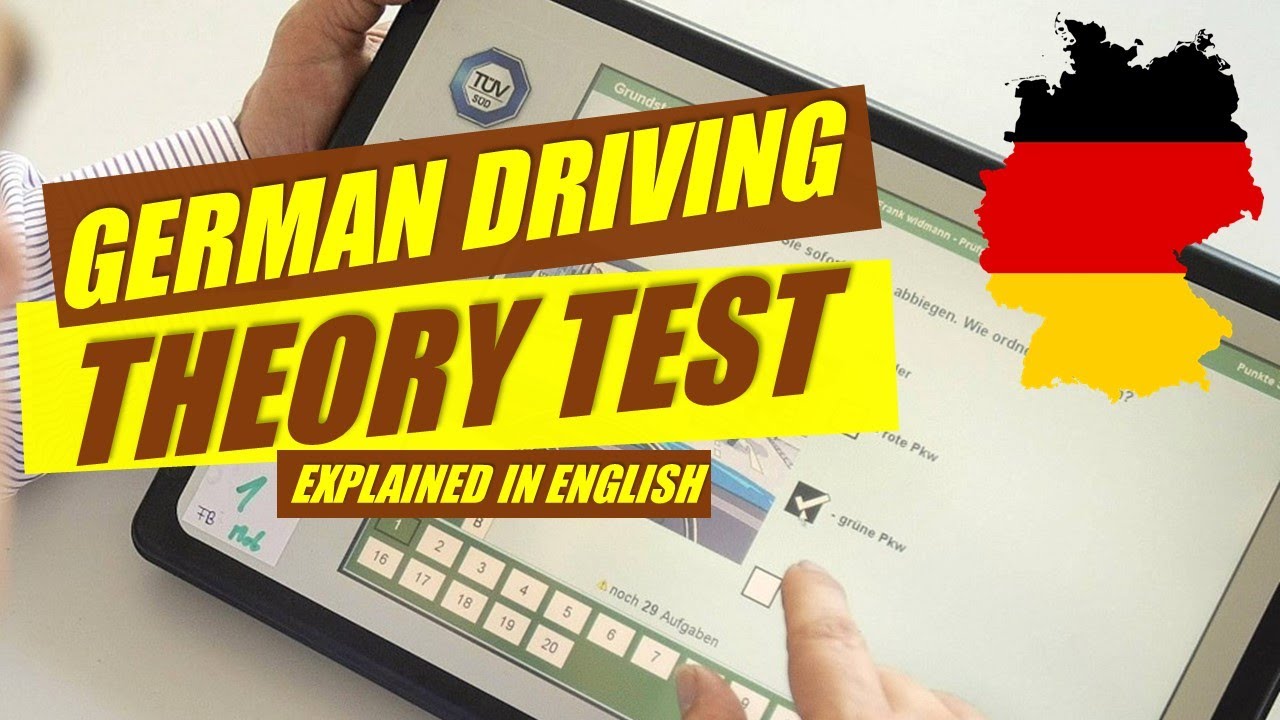
25 questions drawn from a pool of over 1,000. Each question is weighted 2 to 5 error points based on safety significance. You can score up to 10 error points total and pass, except if you miss two 5-point questions. Two 5-pointers fail you regardless of the rest.
The test is available in 12 languages including English, Turkish, Russian, Arabic, and Spanish. Book the language when you book the slot, not on the day.
The mistake we see most: people memorize answers from the app instead of understanding the underlying rule. The official Fragenkatalog rotates wording, and memorization fails when phrasing shifts. Aim for 95%+ accuracy on practice tests for two weeks straight before booking the exam. That buffer absorbs the unfamiliar wording on test day.
How Many Questions In German Driving Test
25 questions per attempt. Mix of basic rules (Grundfragen) and class-specific questions (Zusatzfragen), with several video-based hazard perception questions. The video questions trip up about 1 in 5 foreign candidates we have coached, because they require split-second judgment that practice apps simulate poorly.
Driving Age In Germany: The Class That Saves Young Drivers Thousands In Insurance
| Class | Minimum Age | Vehicle | Note |
|---|---|---|---|
| AM | 15 | Mopeds up to 45 km/h | Often combined with B license at no extra theory cost |
| A1 | 16 | Motorcycles up to 125 cc | |
| BF17 | 17 | Cars (Class B with mentor) | The smartest insurance move available |
| B | 18 | Cars | |
| C1 | 18 | Trucks 3.5 to 7.5 tonnes | |
| C | 21 | Trucks over 7.5 tonnes | Requires BKrFQG |
| D | 24 | Buses | Requires P-Schein |
The BF17 insider tip: insurance companies in Germany consistently discount premiums by 15% to 30% for drivers who completed BF17. The reasoning is statistical. A 2022 BASt study found BF17 drivers had roughly 20% fewer accidents in their first two years of solo driving. The Begleitperson must be 30+, have held their license for 5+ years, and have no more than 1 point in Flensburg.
The Probezeit Is Where Foreigners Get Burned
Two years from the day your license is issued, you are on probation. The rules tighten significantly:
- 0.0 ‰ alcohol limit, even at age 35 if you just got your license
- One A-Verstoß (serious infraction like phone use, running a red light, speeding by 21+ km/h) triggers a mandatory Aufbauseminar at €350 to €450 and extends your Probezeit by 2 years
- Two A-Verstöße triggers a written warning and a recommendation for paid psychological counseling
- Three A-Verstöße means license withdrawal
We have seen a client lose his license 11 months into his Probezeit for a second phone violation. He had to wait, complete an MPU, and retest entirely. Total cost: over €2,000 plus a year without driving privileges.
How Many Driving Lessons Do I Need In Germany: The Honest Average Versus The Fahrschule Pitch
The legal minimums are fixed. The practical reality is not.
Mandatory minimums (Class B):
- 14 double theory lessons (12 general + 2 class-specific), each 90 minutes
- 12 Sonderfahrten: 5 Landstraße, 4 Autobahn, 3 Nachtfahrt
What people actually need beyond that:
In our tracking of 30+ Class B candidates over 2022 and 2023:
- Drivers with prior license experience (converters): 8 to 15 regular lessons
- Complete beginners over 30: 28 to 38 regular lessons
- Complete beginners under 25: 18 to 28 regular lessons
- Drivers transitioning from automatic-only home countries to a manual: add 6 to 10 lessons
The Sonderfahrten are not optional and not flexible. They are also typically priced 20% to 30% higher per session than regular lessons. Budget €60 to €80 per Sonderfahrt.
Can I Drive In Germany With A US License: The State-By-State Reality
Six months from your Anmeldung, full stop. After that, your US license is legally invalid for use in Germany. The conversion process depends entirely on which state issued your license.
What The Reciprocity List Actually Looks Like
Full reciprocity (no exams, just paperwork): Alabama, Arizona, Arkansas, Colorado, Delaware, Idaho, Illinois, Indiana (Class D only), Iowa, Kansas, Kentucky, Louisiana, Maryland, Massachusetts, Michigan, Mississippi, Missouri, Montana, Nebraska, New Mexico, North Carolina, North Dakota, Ohio, Oklahoma, Pennsylvania, Puerto Rico, South Carolina, South Dakota, Tennessee, Texas, Utah, Virginia, Washington State, West Virginia, Wisconsin, Wyoming, D.C.
Partial reciprocity (theory test required, sometimes practical): California, Connecticut, Florida, Georgia, Hawaii, Maine, Minnesota, Nevada, New Hampshire, New Jersey, New York, Oregon, Rhode Island, Vermont, Alaska
A Texas client of ours converted in three weeks for €85 total. A California client paid €1,400 and took 4 months because California falls in the partial-reciprocity bucket requiring the full theory test. Same country, completely different process. Always verify with the BMDV list before assuming.
Join Drivers Who Passed TÜV First Time
Follow the structured Fahrschule process, master the 25-question theory system, and avoid costly retakes. Thousands succeed each year by preparing the right way.
Convert Indian Driving License To German: Why It Is Essentially Starting Over
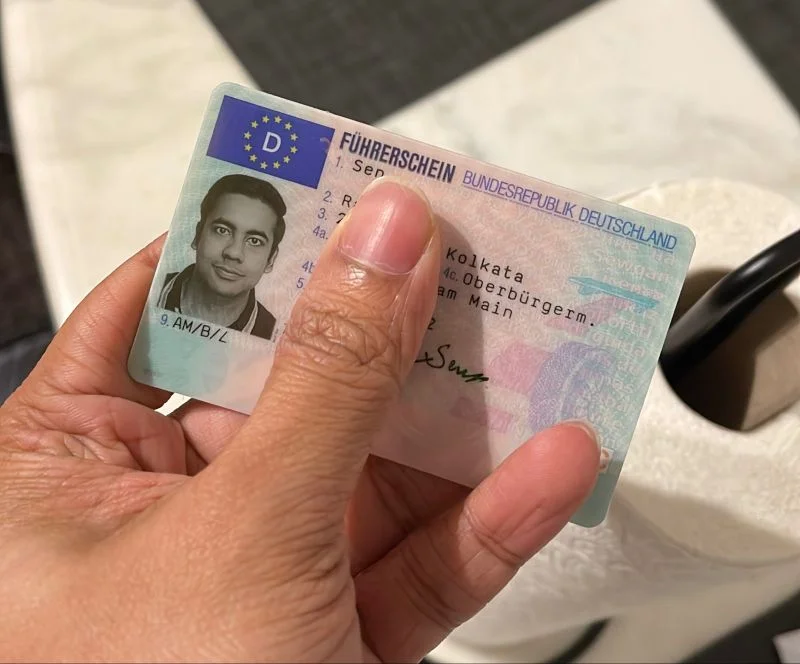
India has no reciprocity agreement with Germany. An Indian license holder must:
- Pass the German theory test
- Pass the German practical test
- Provide a certified German translation of the Indian license
- Complete eye test and first aid course
- Enroll in a Fahrschule
The one benefit: you usually do not need the full 14 mandatory theory lessons. Most Fahrschulen will assess your existing knowledge and waive part of the requirement, saving €200 to €400. Practical lesson requirements depend on the instructor’s evaluation, but expect at least 10 to 15 lessons to adapt to German road conventions, particularly Rechts vor Links and Autobahn discipline.
A Real Conversion Timeline We Walked Through
A client from Pune, residing in Frankfurt since February 2023:
- February: Anmeldung completed
- March: Eye test, first aid, biometric photos, translation ordered (€45)
- April: File opened at Fahrerlaubnisbehörde, enrolled in Fahrschule
- May to July: Theory preparation in English, exam passed on second attempt (€50)
- July to September: 14 practical lessons including all 12 Sonderfahrten
- October: Practical exam passed first attempt
- November: License card collected
Total cost: €2,640. Total time from Anmeldung to plastic: 9 months. He pushed it close. We have seen others miss the 6-month gap entirely and end up insurance-exposed for the final 3 months. His advice: “Start the file the same week you do your Anmeldung. Do not wait for anything.”
The Four Foreign-Conversion Myths That Will Not Die
- “My IDP means I do not need to convert.” False. IDP is a translation, not a license extension.
- “My country is in the G20, so my license is recognized.” Partially false. Japan yes, India no, China no. Check the official BMDV list.
- “I can reset the 6 months by leaving Germany every 5 months.” False. The clock is tied to your registered residence, not your physical presence. Short trips do not reset anything.
- “I do not need a Fahrschule if I am converting.” Sometimes false. Even when theory lessons are waived, the Fahrschule is your only path to the exam booking system and an exam-spec vehicle.
Types Of Driving License In Germany: The Class That Matters For Most Expats
| Class | What You Can Drive | Min Age | Notes For Foreign Drivers |
|---|---|---|---|
| AM | Mopeds, light quads | 15 | Often bundled free with Class B |
| A1 | Motorcycles up to 125 cc | 16 | Separate exam |
| A2 | Motorcycles up to 35 kW | 18 | |
| A | All motorcycles | 24 (direct) or 20 (after 2 years A2) | |
| B | Cars up to 3.5 tonnes, 8 passengers | 18 (17 BF17) | What 95% of foreigners need |
| BE | Car plus heavy trailer | 18 | Required for larger caravans |
| C1/C | Trucks | 18/21 | Commercial use requires BKrFQG |
| D1/D | Buses | 21/24 | Commercial use requires P-Schein |
The automatic transmission trap: if you take your practical exam in an automatic, your license is restricted to automatics only (code B197 or B78). The B197 option introduced in 2021 lets you train mostly in automatic but still drive manual after license issuance, provided you complete 10 lessons in a manual car and a 15-minute manual evaluation. This is a game-changer for foreigners who learned on automatics back home but want manual privileges here.
German Driving License Valid In Which Countries: Where The Card Works Without Questions
| Region | Status | IDP Needed |
|---|---|---|
| EU and EEA | Full recognition | No |
| Switzerland, UK | Full recognition | No |
| USA, Canada | Valid for tourist visits, ~6 months | Recommended |
| Australia, NZ | Valid 3 months | Recommended |
| Most of Asia, Africa, South America | Variable | Almost always required |
The IDP costs €15 to €17 from the ADAC, takes about 10 minutes to issue if you walk in with your German license and a photo, and lasts 3 years. We tell every client traveling outside Europe to get one preemptively. The €17 buys you immunity from local rental car drama and roadside translation arguments.
Replacement Driving Licence After Loss Or Theft: The 6-Week Gap Most People Are Unprepared For
- File a police report immediately. This is free and protects you legally if someone misuses the lost card.
- Apply at your Fahrerlaubnisbehörde. Bring passport, police report, biometric photo, Anmeldung, and ideally your old license number.
- Wait 4 to 8 weeks for the new card. Express service (where available) takes 1 to 2 weeks and costs an extra €15 to €25.
You can request a vorläufige Fahrberechtigung (temporary driving authorization) that covers you within Germany during the wait. It does not work abroad. We had a client lose her license in May, request the temporary document, then discover she could not legally rent a car for her June vacation in Italy. The express fee would have saved the trip.
What Happens If You Drive In Germany Without A License: The Criminal Record People Do Not See Coming
This is a Straftat (criminal offense) under § 21 StVG, not a Bußgeldverstoß (administrative fine). The distinction matters enormously.
- First offense: up to €1,000 fine or up to 1 year imprisonment. Vehicle confiscation possible.
- Repeat offense: higher fines, prison time, and a driving ban of up to 5 years before you can reapply.
- Criminal record: entered into the Führungszeugnis, visible to employers and immigration authorities. Non-citizens have had visa renewals denied over this.
- Insurance: void from the moment your license expired. Any accident becomes personal liability. We have seen this destroy savings.
- Future licensing: an MPU (Medizinisch-Psychologische Untersuchung) is often required before relicensing. MPU costs €450 to €750 and has a roughly 60% pass rate on the first attempt.
The MPU is the German driving system’s most feared assessment. Plan never to need one.
What Happens If I Drink Alcohol And Drive A Car Or Motorcycle: The Per-Mille Math That Decides Your Future
| BAC Level | Driver Status | Consequence |
|---|---|---|
| 0.0 to 0.49 ‰ | Probezeit or under 21 | €250 to €500 fine, 1 point, mandatory Aufbauseminar (€350+), Probezeit extended 2 years |
| 0.5 to 1.09 ‰ | Experienced, no impairment | €500 fine first offense, 2 points, 1-month driving ban |
| 0.3 to 1.09 ‰ | Experienced, with impairment signs | Criminal offense, license withdrawal, possible MPU |
| 1.1 ‰ and above | Any | Criminal offense, minimum 6-month license withdrawal, almost certain MPU, 3 points |
The cyclist warning nobody mentions: at 1.6 ‰ BAC on a bicycle, you face the same consequences as drunk driving in a car, including loss of your car license and MPU requirement. Local police in Berlin and Cologne specifically target bike paths during Karneval and Oktoberfest periods. Several clients have lost their car licenses through bike incidents.
Driving License In Germany For Foreigners: The Status-Specific Rules That Get Missed
Students: the 6-month rule applies if your “center of vital interests” (Lebensmittelpunkt) is in Germany. For most degree students, it is. The student exemption many people repeat online does not legally exist in current FeV.
Diplomats: holders of a Diplomatenausweis from the Foreign Office can usually drive on their home license throughout their posting under the Vienna Convention on Diplomatic Relations. Family members of diplomats sometimes share this privilege, sometimes not. Verify with your embassy’s legal section.
Posted workers and short-term assignments: the 6-month clock still starts at Anmeldung. The only way to legally extend driving on a foreign license is to not register as a resident, which has its own tax and visa complications.
Asylum seekers and refugees: rules vary dramatically based on documentation. Some Fahrerlaubnisbehörden accept UNHCR documentation in place of an original license that cannot be retrieved. This is handled case by case.
Download The Complete License Cost Breakdown
See the real 2023 Class B cost range (€1,500–€3,500+) with exam fees, special drives, and retake risks clearly mapped. Budget accurately before enrolling.
Frequently Asked Questions About Driving License In Germany
Can Driving License In Germany Be Used In Other Countries?
Yes, throughout the EU and EEA with no additional documents. For travel outside Europe, including the US, Canada, Australia, and most of Asia, get an IDP from the ADAC for €17. The IDP is mandatory in many rental car contracts even where local law might technically accept your German license alone. We tell every client to budget for one before any non-EU trip longer than a week.
How To Get A Driving License In Germany?
Register your residence (Anmeldung), book an eye test and first aid course in the same week, gather biometric photos and your passport, then open a file at the Fahrerlaubnisbehörde before enrolling in a Fahrschule. Complete theory training, pass the 25-question theory test, complete practical lessons including 12 mandatory Sonderfahrten, then pass the practical exam. Total timeline ranges from 3 months (experienced converters in small cities) to 9 months (beginners in Munich or Berlin).